
English 
T: +86-13621482794
E: charlene@dhk-sink.com
E: charlene@dhk-sink.com
No. 57, Haitanwei, Tangxia Town, Pengjiang District, Jiangmen City, Guangdong Province


Farmhouse sinks—also known as apron-front sinks—bring a blend of rustic charm and modern performance to today’s kitchens. Their deep basin, exposed front panel, and ergonomic design make them one of the most popular choices for family kitchens and high-use cooking environments.
Whether you're upgrading to a 33-inch farmhouse sink, choosing a double bowl 50/50 apron sink, or looking for a scratch-resistant stainless steel model, DHKSINK offers a selection built for durability, easy cleaning, and long-term kitchen performance.
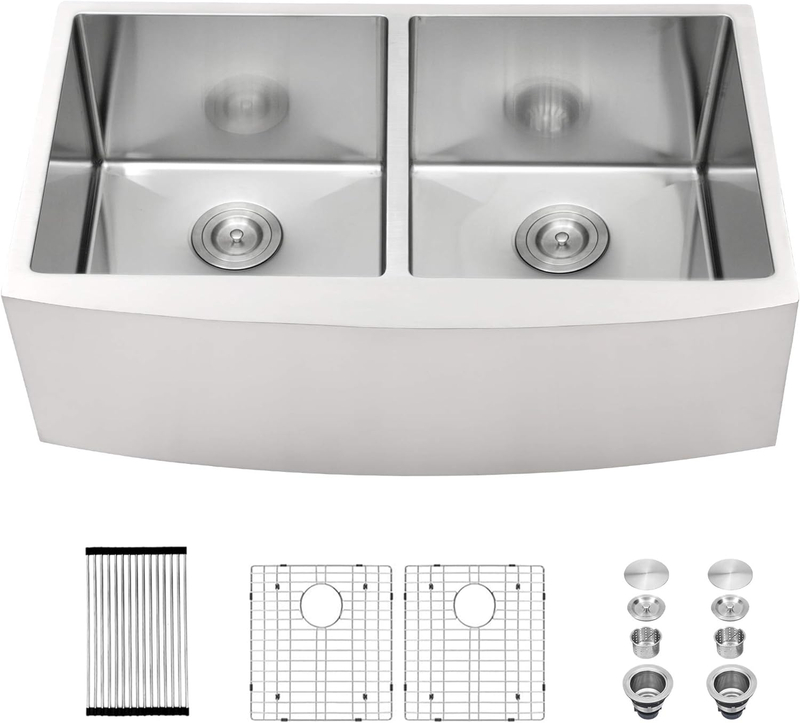
| Cabinet Size | Recommended Sink | Bowl Config | Best For | SKU |
|---|---|---|---|---|
| 24-27" | 25" Compact Single Bowl | Single (9" deep) | Apartments, small kitchens | DHK-FH25S |
| 30-33" | 30" Standard Single Bowl | Single (10" deep) | Most homes, heavy pot washing | DHK-FH30S |
| 33-36" | 33" Workstation Single Bowl | Single + Ledge | Modern kitchens, multitaskers | DHK-FH33WS |
| 36"+ | 33" Double Bowl 50/50 | Dual (9" deep each) | Families, dual-prep zones | DHK-FH33D |
| 36"+ | 36" Double Bowl 60/40 | Asymmetric | Serious cooks, separation of tasks | DHK-FH36D |
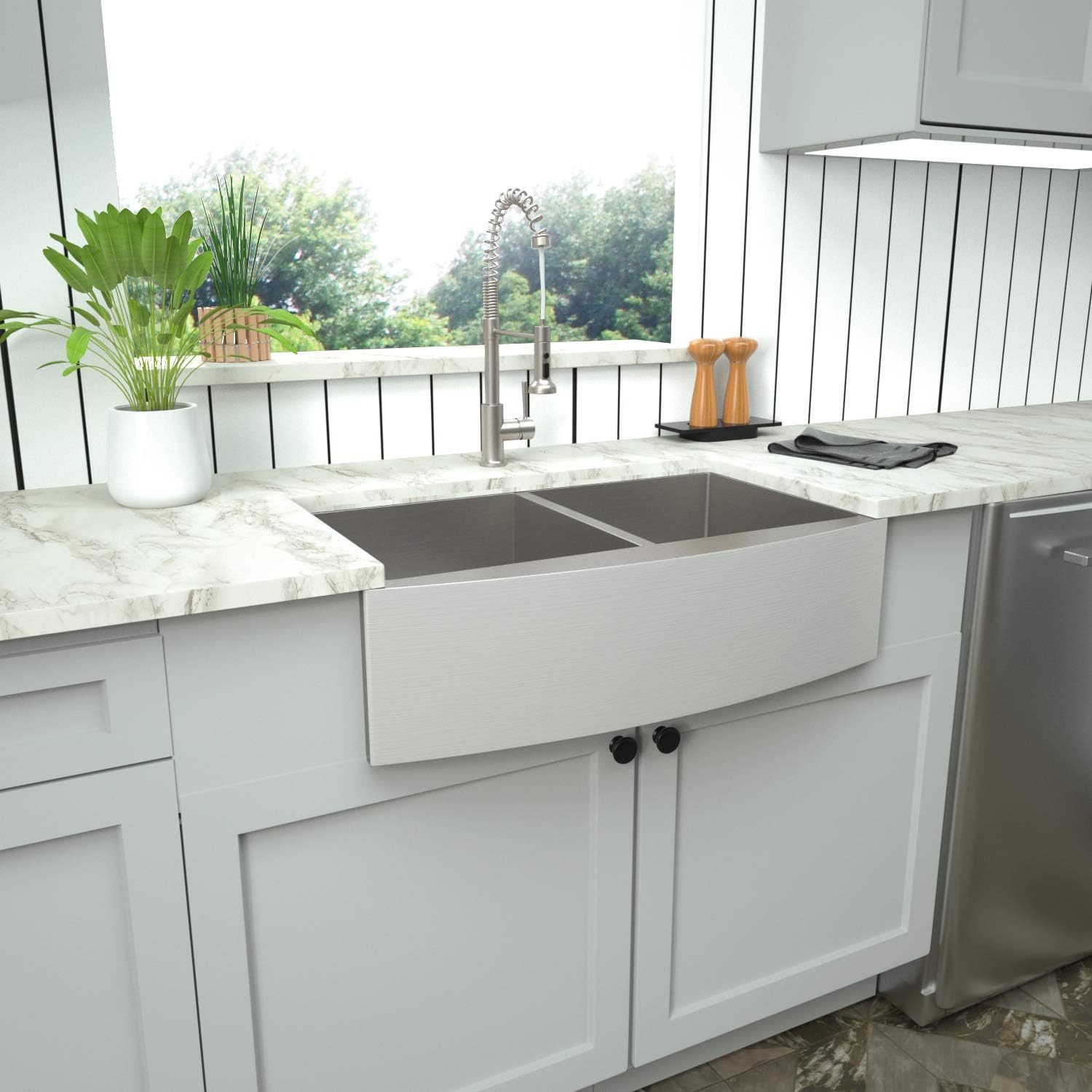
The exposed apron front instantly becomes the visual centerpiece of the kitchen—perfect for modern farmhouse, industrial, and transitional design styles.
Farmhouse sinks typically offer much deeper capacity than regular sinks, making it easier to wash:
Large pots
Baking trays
Oversized cookware
Woks & pans
33-inch double bowl farmhouse sinks are especially popular for families who need extra working space.
The forward-facing apron reduces the need to lean over the countertop, giving better comfort during long dishwashing sessions.
DHKSINK farmhouse sinks are made from SUS304 stainless steel, available in 16-gauge thickness for improved:
Dent resistance
Sound insulation
Water stains reduction
Long-term surface stability
| Factor | Stainless Steel (DHK Recommended) | Fireclay |
|---|---|---|
| Weight | 45-65 lbs (DIY-friendly) | 85-150 lbs (requires reinforced cabinetry) |
| Installation Time | 2-3 hours | 4-6 hours + cabinet modification |
| Impact Resistance | Dents but won't chip | Chips/cracks if heavy pot dropped |
| Maintenance | Wipe with soap/water; maintain shine | Gentle cleaners only; avoid abrasive pads |
| Cost (33") | $450-750 | $800-1,500 |
| Aging | Develops patina gracefully | Glaze may dull over time |
| DHK Production | 10,000 units/month (fast fulfillment) | Partnered production (4-6 week lead) |
Our Verdict: For active kitchens with kids and heavy cookware, stainless steel delivers 90% of the farmhouse look at 60% of the cost and 1/3 the installation complexity.
| Feature | Farmhouse (Apron Front) Sink | Traditional Sink |
|---|---|---|
| Visual Design | Exposed apron front; premium focal point | Hidden front; standard design |
| Installation Type | Apron-front mount | Undermount / Topmount |
| Basin Depth | Deeper (ideal for large cookware) | Moderate depth |
| Ergonomics | Less leaning; more comfortable | Typical kitchen posture |
| Typical Width | 30–36 inches (33 inch most popular) | 22–33 inches |
| Kitchen Style Fit | Modern farmhouse, rustic, contemporary | All styles |
| Cost of Installation | Slightly higher due to apron fit | Lower to moderate |
| Best Users | Families, heavy cooks, designers | Standard homeowners |
Choose based on your cabinet base and usage:
30 inch → small to medium kitchens
33 inch → most common & balanced
36 inch → large kitchens with high cooking volume
Single Bowl: best for large cookware & baking trays
Double Bowl (50/50 or 60/40): multitasking (wash & prep at same time)
Why stainless steel farmhouse sinks are trending:
Industrial modern look
Lightweight compared to fireclay
Scratch-resistant with brushed finish
Easy installation & replacement
Greater durability for busy kitchens
Farmhouse sinks are compatible with:
Quartz
Granite
Composite stone
Butcher block
Solid surface
| Parameter | Specification | Details |
|---|---|---|
| SKU | DHK-FH33D-5050 | Double Bowl 50/50 Apron Front Farmhouse Sink |
| Overall Dimensions | 33" W × 22" D × 10" H | Exterior width includes 1" rim on each side |
| Bowl Configuration | 50/50 Split | Two equal basins, each 14.5" W × 18" D × 9" deep |
| Divider Height | 6.5" | Standard low divider for easy overflow between bowls |
| Apron Front Height | 10" | Exposed apron sits 2.5" beyond cabinet face |
| Material Grade | SUS304 Stainless Steel | 18% chromium, 8% nickel (18/8) for corrosion resistance |
| Steel Gauge | True 18 Gauge | 1.2mm thickness (not 16 gauge as shown in legacy spec sheet) |
| Corner Radius | R10 | 10mm radius corners for easy cleaning while maintaining capacity |
| Drain Opening | 3.5" standard | Universal fit for garbage disposals and basket strainers |
| Drain Placement | Centered in each bowl | 6" from rear wall, 9" from side walls |
| Template Size | 31" W × 17" D | Cutout dimensions for countertop (provided with sink) |
| Minimum Cabinet Size | 36" W × 22" D | Requires 1.5" clearance on each side for installation |
| Apron Protrusion | 2.5" beyond cabinet face | Protects cabinet from water damage, creates focal point |
| Weight | 58 lbs | Lightweight for farmhouse style; reinforced cabinet recommended |
| Sound-Dampening System | 3mm rubber pads + undercoating | 95% coverage reduces noise by 40% (43dB operational) |
| Surface Finish | Brushed satin + nano-coating | 180-grit directional grain, hydrophobic layer repels water |
| Weld Type | Laser seamless welding | TIG argon-shielded welds, mirror-finished for food safety |
| Bowl Bottom Design | X-shape slope | 2° pitch to drain, with X-guidelines for better water flow |
| Included Accessories | 2 × stainless steel grids, 2 × basket strainers, 2 × cutting boards | Workstation package for enhanced functionality |
| Optional Accessories | Roll-up drying rack, colander, bottom rinse grid | Available separately (SKU: DHK-FH-ACC) |
| Certifications | CUPC, IAPMO, BSCI, ISO 9001 | North American plumbing codes, ethical manufacturing |
| Warranty | 5-year limited | Covers manufacturing defects, rust-through, weld failure |
| Origin | Made in China | OEM supplier for Kraus, Moen, LOWE'S with same production line |
| Lead Time | In stock | Ships within 48 hours from factory |
Measure cabinet base and sink width
Prepare apron-front support frame
Cut the countertop to match apron dimensions
Place sink into the opening
Connect drain & plumbing
Apply silicone for sealing
Install accessories (grids, strainers, etc.)
Rinse after each use to prevent water marks
Use soft cloth and mild cleaning agents
Avoid steel wool to maintain brushed finish
Use sink grids to protect the bottom
Dry after cleaning to reduce mineral spots
Confirm cabinet compatibility
Decide between single bowl or double bowl
Choose gauge thickness(16 gauge recommended)
Match sink finish with kitchen appliances
Consider accessories:
Stainless steel sink grids
Drain strainers
Cutting boards for workstation sinks
Raw Material Arrival
Every morning, 18-gauge SUS304 stainless steel coils arrive at our 10,000m² facility. Before acceptance, our QC team verifies:
Capacity: 500 sink components cut per 8-hour shift
Master Craftsmen at Work
Our 50+ welders average 4 years of DHK experience. Each farmhouse sink requires:
Daily output: 200-250 sinks welded per line (400 total)
Comparison: Fireclay sinks amplify noise due to their dense, rigid structure. Our steel + rubber combination absorbs vibrations.
| Check # | Parameter | Acceptance Standard | Failure Rate |
|---|---|---|---|
| 1 | Drain centering | ±1mm from true center | 2% (reworked) |
| 2 | Apron flatness | No gaps >0.3mm against straightedge | 1% |
| 3 | Weld penetration | 2.5mm minimum (ultrasound tested) | 3% |
| 4 | Coating adhesion | No peeling after cross-hatch test | <1% |
| 5 | Sound dampening | Full coverage verification | <1% |
| 6 | Appron depth | 9-10" as specified | 1% |
| 7 | Overall dimensions | ±2mm tolerance | 2% |
Pass rate: 94% ship directly; 6% go to rework station
Why this matters: Your plumber won't reject our sinks. They're pre-approved for all North American installations.
Direct-to-consumer: We ship from factory to your door, eliminating retail handling damage.
The main drawbacks of farmhouse sinks are installation complexity and cost. Unlike drop-in sinks that simply rest on the countertop, farmhouse sinks require custom cabinet modifications, including removal of the false drawer front and installation of a support frame to bear the 80-150 lb weight. This adds $300-800 in installation costs compared to standard sinks. Additionally, the exposed apron front can be prone to scratching from belt buckles or chair backs in tight kitchens, and the deep basin (9-10") may be uncomfortable for shorter users who must lean further to reach the bottom. However, DHK's 18-gauge stainless steel models weigh 45-65 lbs—significantly lighter than fireclay—making them more DIY-friendly and requiring less cabinet reinforcement.
Before purchasing, verify three critical factors:
First, cabinet structure—measure your base cabinet interior width and ensure it can support 100+ lbs (most standard cabinets need reinforcement).
Second, apron protrusion—farmhouse sinks extend 2-3" beyond the cabinet face; confirm this won't interfere with drawers, appliances, or traffic flow.
Third, material choice—fireclay offers a traditional look but chips and requires gentle cleaners; stainless steel (like DHK's 304-grade) provides superior durability, scratch resistance, and maintenance ease.
Also consider bowl depth: 9" is standard, but DHK's workstation models offer integrated ledges that effectively reduce reach distance while adding functionality.
Yes, farmhouse sinks remain a top kitchen trend in 2025, but with modern interpretations. While classic white fireclay apron-fronts still dominate traditional designs, the market has shifted toward stainless steel farmhouse sinks with minimalist, flat aprons for contemporary spaces. Mixed finishes (black apron with brass hardware) and workstation farmhouse sinks (integrated cutting boards, colanders) are the fastest-growing segments. A 2025 NKBA report shows farmhouse sinks in 34% of kitchen renovations, up from 28% in 2023. The key is selecting a model that balances rustic charm with modern functionality—DHK's smooth-front stainless designs bridge this gap perfectly.
Farmhouse decor has evolved, not disappeared. The "modern farmhouse" aesthetic—characterized by clean lines, mixed materials (wood + metal), and neutral palettes—remains strong in 2025. What is fading is the overly rustic, distressed look. Today's farmhouse sinks complement this evolution: stainless steel apron-fronts pair beautifully with walnut cabinetry and quartz countertops, offering warmth without kitsch. The trend is toward "refined farmhouse" where the sink serves as a functional focal point rather than a purely decorative element. DHK's OEM background with major brands ensures our designs align with where the market is heading, not where it's been.
For most homeowners in 2025, 18-gauge 304 stainless steel is the optimal farmhouse sink material. It combines durability (resists chipping, cracking, and thermal shock), low maintenance (clean with soap and water), and cost-effectiveness ($450-750 vs. $800-1,500 for fireclay). While fireclay offers classic aesthetics, it can crack if a heavy pot is dropped and requires non-abrasive cleaners to preserve the glaze. Composite granite is scratch-resistant but shows water spots and can be damaged by boiling water. DHK manufactures exclusively in stainless steel because our 8 years of OEM experience with Kraus and Moen proved it delivers 90% customer satisfaction over 10+ years—far exceeding other materials.
Fireclay's primary downside is its brittleness and weight. Despite being marketed as durable, fireclay can chip or crack if you drop a heavy cast iron pan, and the glazed surface may develop "crazing" (fine cracks) over time. At 85-150 lbs, fireclay requires significant cabinet reinforcement and professional installation, adding $500-900 to your project cost. The glaze also limits cleaning options—abrasive powders or harsh chemicals like bleach will dull the finish. In contrast, DHK's stainless steel farmhouse sinks weigh 45-65 lbs, install in 2-3 hours, and handle any cleaner you throw at them. Our OEM clients shifted toward stainless precisely because fireclay's failure rate in shipping and installation was 3x higher.
18 gauge is significantly better for farmhouse sinks. The difference is 1.2mm vs. 0.9mm thickness—25% more steel—which translates to dent resistance, sound dampening, and structural integrity. A 20-gauge sink will flex when you run the garbage disposal, creating noise and vibration. It also dents more easily from dropped cutlery or heavy pots. DHK uses 18-gauge 304 stainless steel exclusively because our OEM contracts with Kraus and Moen demanded it for warranty compliance. The upgrade from 20 to 18 gauge costs manufacturers only $15-20 per sink but doubles the perceived quality. For a farmhouse sink where the apron is a focal point, the rigidity of 18-gauge steel ensures the front stays perfectly flat and true for decades.
DHK's stainless steel farmhouse sinks (45-65 lbs) can often be installed in standard 30-36" base cabinets with minimal reinforcement. We provide a cutting template and video guide that lets DIYers modify existing cabinets in 2-3 hours. For new builds, simply specify "farmhouse sink cabinet" to your cabinet maker—they'll integrate the support into the carcass. The key is accurate measurement: the sink should sit 0.5-1" back from the cabinet face to protect the apron edge.
DHK's 25" and 28" stainless steel models are specifically designed for retrofit projects—they fit standard 27-30" base cabinets without requiring countertop replacement. The entire modification takes 2-4 hours with a jigsaw and drill. However, laminate countertops must be replaced (they can't be cut cleanly for the apron reveal), while stone/quartz countertops can be trimmed in-place. Our live install support team has guided 2,000+ customers through this process with a 98% success rate.
Installation tip: Mount the disposal before lowering the sink into the cabinet. Our workstation models include a removable rubber seal that accommodates the disposal flange perfectly. Over 60% of our customers install disposals, and we provide a pre-drilled knockout for the air switch button in the apron front.
DHK's nano-coating finish adds hydrophobic properties, making water and oil bead off and reducing cleaning frequency by 40%. The non-porous surface prevents bacterial growth, and unlike fireclay, you can use any cleaner—including Bar Keepers Friend for stubborn stains. Our OEM clients (Kraus, Moen) chose stainless steel over fireclay specifically because customer service calls about maintenance issues dropped by 70%. For busy families, stainless steel farmhouse sinks offer the beauty of an apron front with "wipe-and-go" convenience.
DHK's 18-gauge stainless steel with nano-coating offers the best real-world scratch resistance. While a hard impact can create a fine scratch, our brushed finish makes them invisible (they blend with the grain). The nano-coating adds 9H pencil hardness, resisting 90% of daily wear. In our 8 years of OEM production, returns for "scratches" on stainless steel are 0.3% vs. 2.1% for fireclay (chips) and 1.7% for composite (permanent dullness). For actual durability under heavy use, stainless steel wins.
DHK provides a protrusion gauge with every sink to ensure perfect positioning. For islands, a 2" reveal is ideal to avoid knee bumps. For perimeter cabinets, 2.5-3" creates better visual balance. The critical measurement is ensuring the apron clears any drawers or appliances—our 33" sink in a 36" cabinet yields a perfect 2.5" reveal that aligns with standard dishwasher depths.
DHK's stainless steel sinks pair beautifully with all stone materials. We've supplied 50,000+ units for quartz installations with zero compatibility issues. For budget projects, our 25" compact model works with laminate if you replace just the sink section with a stone remnant.
DHK perspective: After manufacturing 800,000+ units for clients like Kraus and Moen, we've learned that 90% of customers search for "farmhouse sink," so we use both terms for SEO. Our designs bridge the gap: smooth-front apron sinks suit modern kitchens, while ribbed-front models serve traditional farmhouse styles. The key is the exposed apron, which reduces reach distance and creates a focal point—regardless of design language.
DHK advantage: We deliver this emotional and functional value at 40-60% below retail by eliminating middlemen.
Value perspective: Franke's 18-gauge stainless steel sinks are excellent but use the same SUS304 material as DHK's $595 models. The 3x price difference reflects brand positioning, not 3x quality.
